Lead engineers are expected to understand the following regarding WUI fires:
The nature of ember storms and their impact on facilities.
Basic principles from NFPA 1144.
With the potential for climate change due to our use of fossil fuels, our program needs to prepare for changing fire conditions. Recent wildland fires
illustrate that changes regarding how wildland fires are managed have resulted in changes to the geometry and loading of combustibles in the wild.
Additional changes that have resulted in firefighters taking less risk have also contributed to increased fire size. These two changes, combined
with the potential changes to climate result in an expected increase in fire intensity and frequency. Ember storms are the threatening result
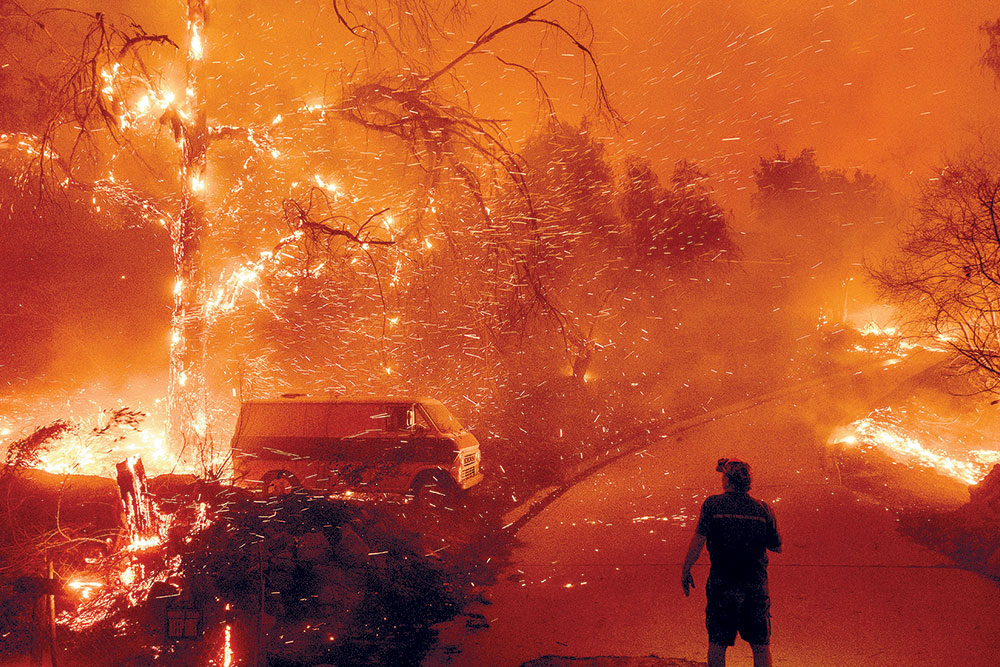
from these changes. Figure 1 shows an image of an ember storm. Combustible loading is not the sole driver for ember storms. The combination of combustible
loading and extreme weather conditions create them.
The Lahiana, Maui fire illustrates this concept. The island of Maui is prone to wildland fires. Similarly, many parts of the world including
Idaho, Pennsylvania and New York
also experience wildfires. The Lahiana example illustrates when severe weather conditions combine with a wildland setting that results in an ember storm
that strikes a city.
Figure 1: Ember storm.
An ember storm always finds the weak link in the fire safety of a facility. The only solution to improve the fire resilience of our facilities when
faced with an impossible to predict weather future is to fire harden structures by using the requirements found in one of many codes. Four standards are easily
available to prepare for wildland related fires:
FMDS 9-19, "Wildland Fire"
NFPA 1144, "Standard for Reducing Structure Ignition Hazards from Wildland Fire"
An ember storm will cause multiple structural fires in facilities that are not fire hardened. Typical emergency response planning involves ensuring a
fire department can address one independent fire, and rarely has the foresight for planning how to control multple ones.
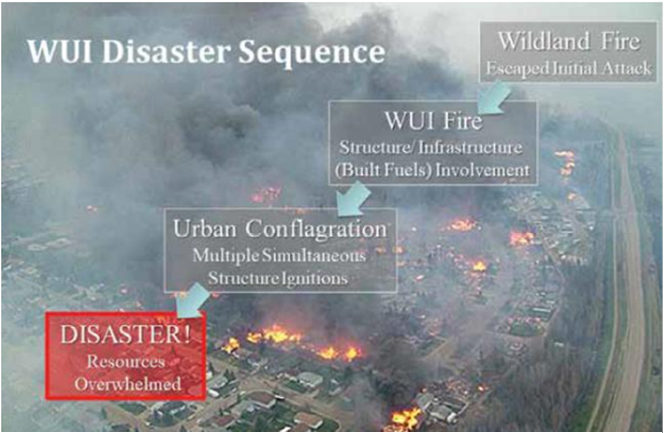
The nature of an ember storm results in multiple fires that quickly overcome the available fire apparatus resulting in an "Urban Conflagration."
Once multiple structures are ignited, there are no solutions to manually suppress or otherwise control those fires. The only solution is upfront planning to ensure
that an ember storm will not result in a conflagration.
Figure 2: Steps to conflagration.
Typical structural fire spread is caused by radiative heat transfer. One building on fire exposes another building to a heat flux sufficient to initate combustion
on its exterior. A wildland fire is typically spread through spotting, where embers can fly a mile from the fire front into weak points in structures. Regardless
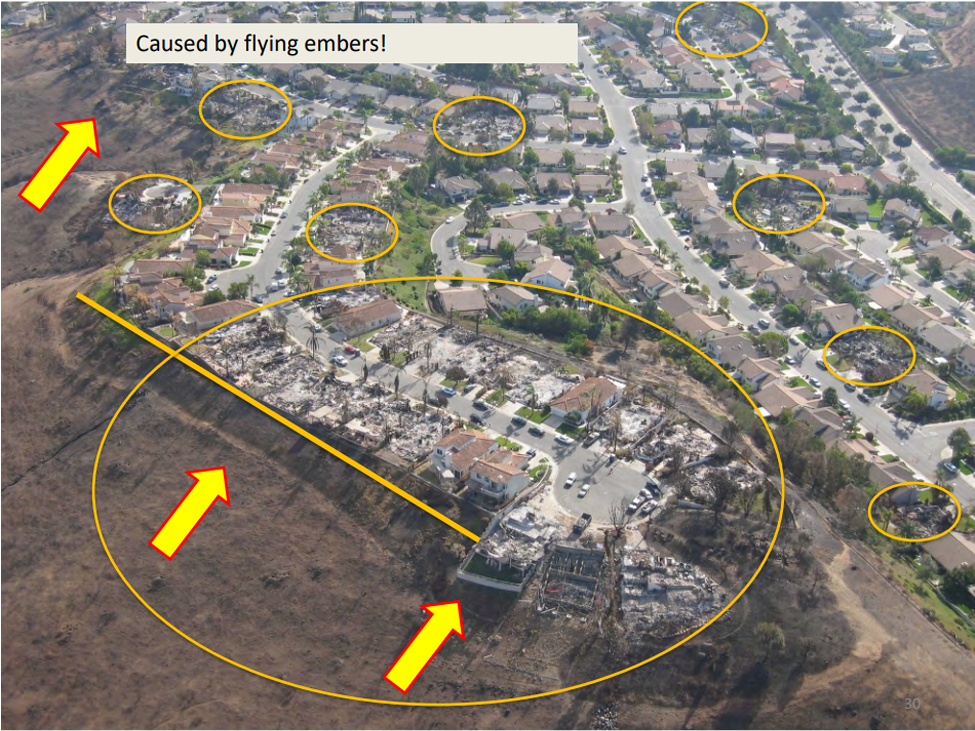
of how well the surrounding of a facility is, it is not likely to prevent embers from a far distance from impacting its location. Figure 3 demonstrates this princple.
This image shows how spot fires occured a significant distance from the flame front in a wildland fire, resulting in multiple structural fires that simulaneously burned
resulting in the fire department to stretch its resources to a point where the fire burned uncontrollably in certain areas.
Figure 3: Spot fires are circled.
The first step in fire hardening a facility is to ensure maintenance is performed. This includes both landscaping, debris removal and maintaining the structure.
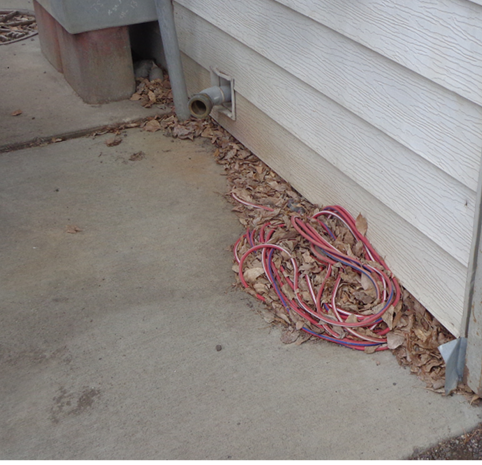
Combustible landscaping is a major source for fire spread in an ember storm. Cleaning up leaves, pine needles and overgrown vegetation is important as these
combustible sources easily combust and provide an exposure heat source for fire spread.
Figure 4: Leaves next to combustible construction.
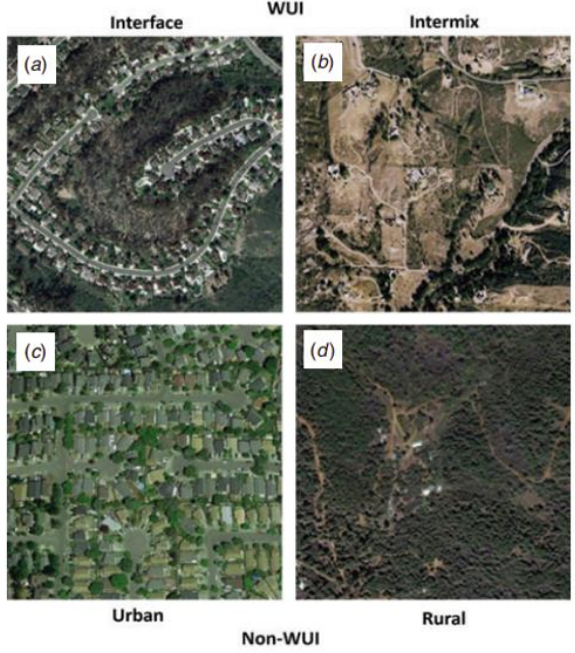
Understanding the landscaping requirements for a particular facility requires understanding the nature of where the facility is. Figure 5 shows different
structural-wildland settings were different strageties need to be employed. WUI is typically defined as one structure in an area of less than 40 acres. Regardless
of the setting as shown in Figure 5, a fire in an adjacent wildland will impact both rural and urban environments due to ember storms. An urban environment next to
wildland and a WUI environment both have specific requirements to minimize the spread of fire.
Figure 5: WUI definitions.
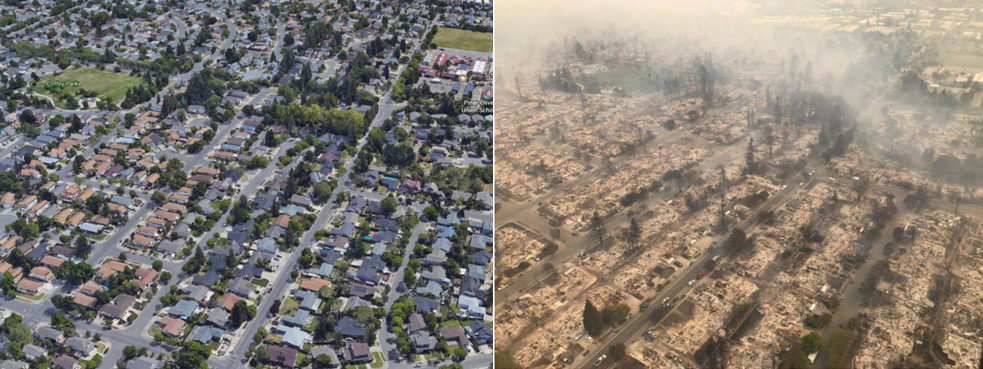
Figure 6 is an example of an urban environment ajacent to a wildland area that experienced complete destruction due to an ember storm. This image could reflect
any of our sites without adequate preparation.
Figure 6: Urban conflagration.
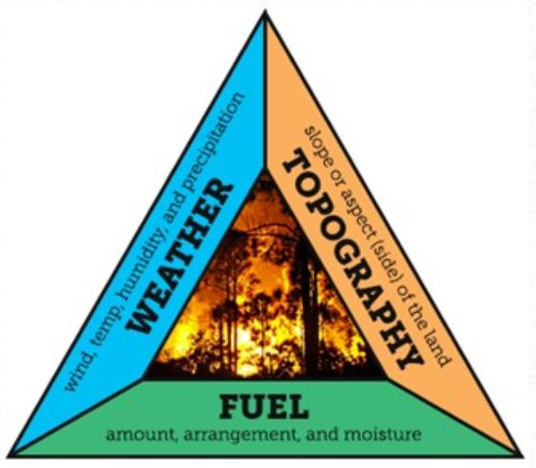
Three factors influence wildland fire as shown in Figure 7. Weather is a primary factor. For instance, the great basin of the intermountain-west, such as
around southern and eastern Idaho have a medium fuel load (Model-T Great Basin Sagebrush). The number of extreme weather days, defined as "red-flag" days typically
exceeds 7. The combination of
a medium fuel load with 8 or more extreme weather days results in an extreme hazard for wildland fire. This situation may be different in places like New York
or Pennsylvania where there are fewer red flag warning days. Regardless, with unique topology such as ravines, in addition to heavy fuel loads, such as forests,
only occasional red flag days may still justify action for wildland fire preparedness. With the unpredicability of weather due to expected climate change,
historical norms for weather behaviour may not be appropriate to forecast future threats for wildland fire.
Figure 7: WUI Factors.
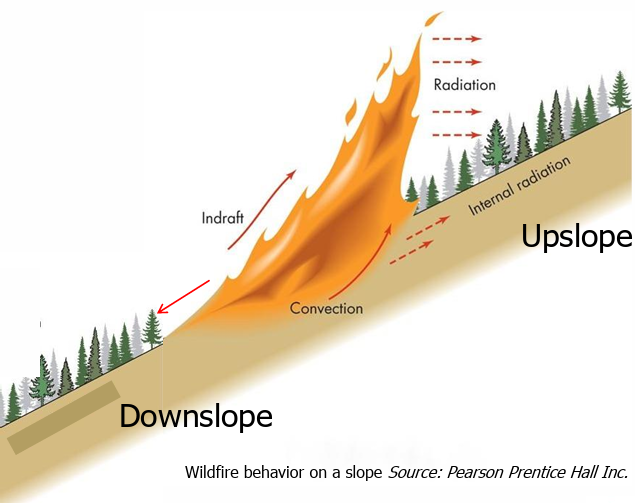
Figure 8 shows an example of how topology affects wildland fire spread. Even medium levels of combustibles can produce extreme wildland fire hazards
if the topology has the right orientation.
Figure 8: Topology influencing fire behaviour.
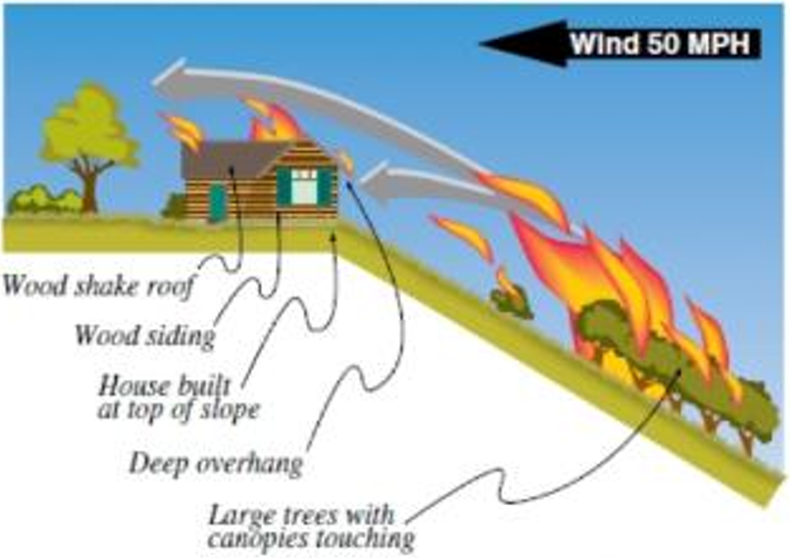
Figure 9 shows an example of how a structure on top of a hill will experience worst conditions than otherwise because of the influence of topology on
fire growth and ember spread.
Figure 9: Topology Orientation Effects.
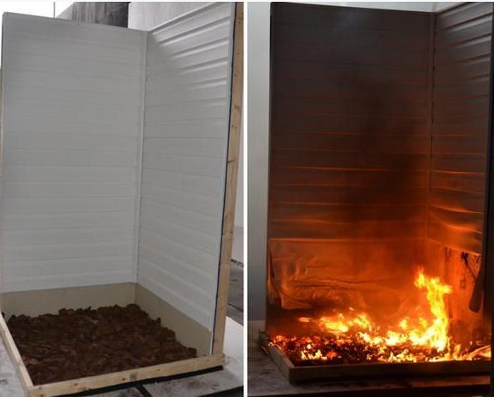
Some universal rules include a prohibition on combusible mulch next to buildings. A laboratory test example is shown in Figure 10 where the text exterior is
vinyl siding and bark mulch is used for landscaping. An ember can easily ignite dry bark dust/mulch, and such landscaping material should be generally avoided
and specifically prohibited within 5' of a structure.
Figure 10: Bark mulch fire test.
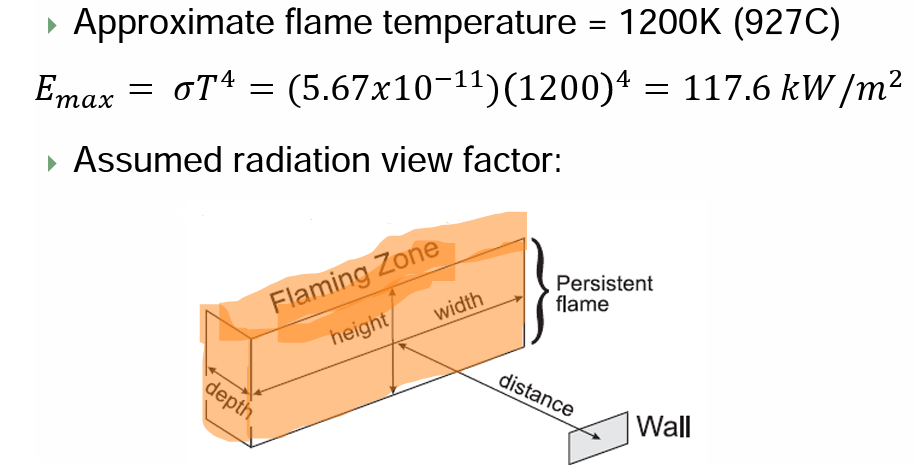
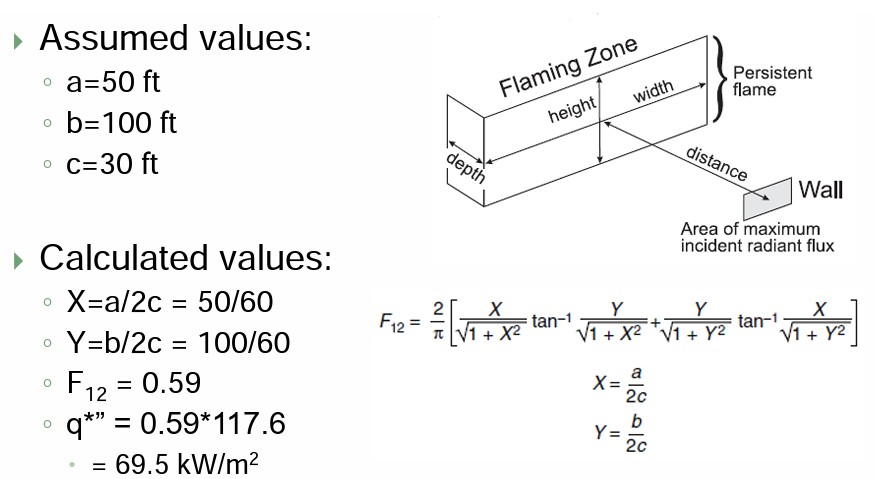
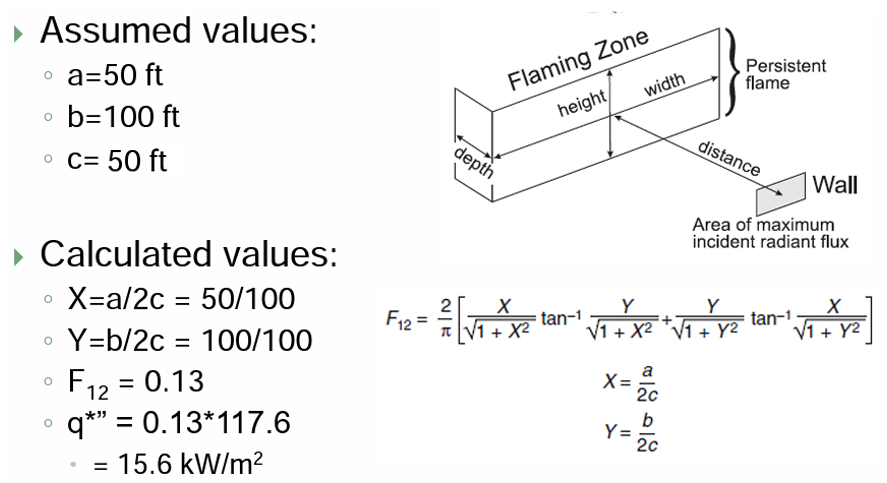
The following images show an example problem where the distance of the wildland is 30' or 50'. It shows the significant difference in
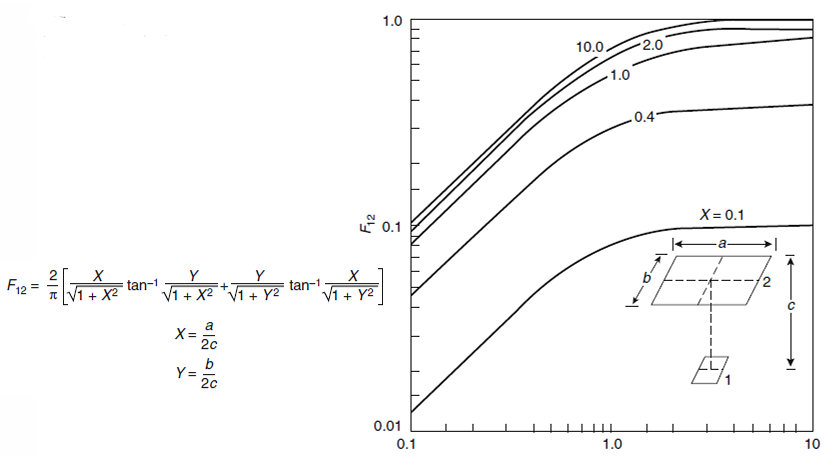
radiative exposure as a function of distance from a wilfire source and how to calculate those heat flux values.
Figure 11: Exposure to a fire source.Figure 12: View Factor from SFPE HFPE App 4.Figure 13: Heat flux at 30'.Figure 14: Heat flux at 50'.
As discussed in the Fire alarm, Detection and Signaling site, the configuration factor plays an important role in estimating the heat flux.
The 30' distance to the target created enough heat flux to ensure rapid ignition at 69.5 kW/m2. By ensuring that there is 50-100' of clearance
between structures and the wildland, the heat flux drops to a point where ignition is not likely to occur.
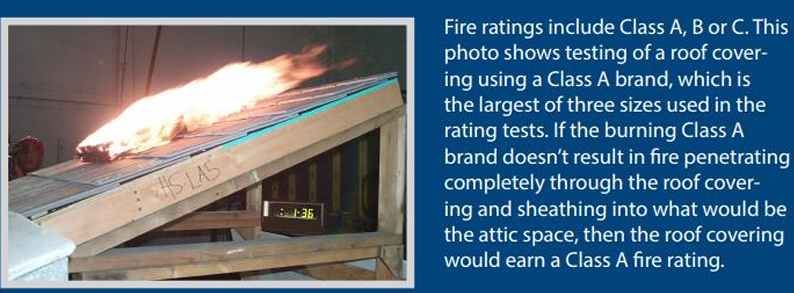
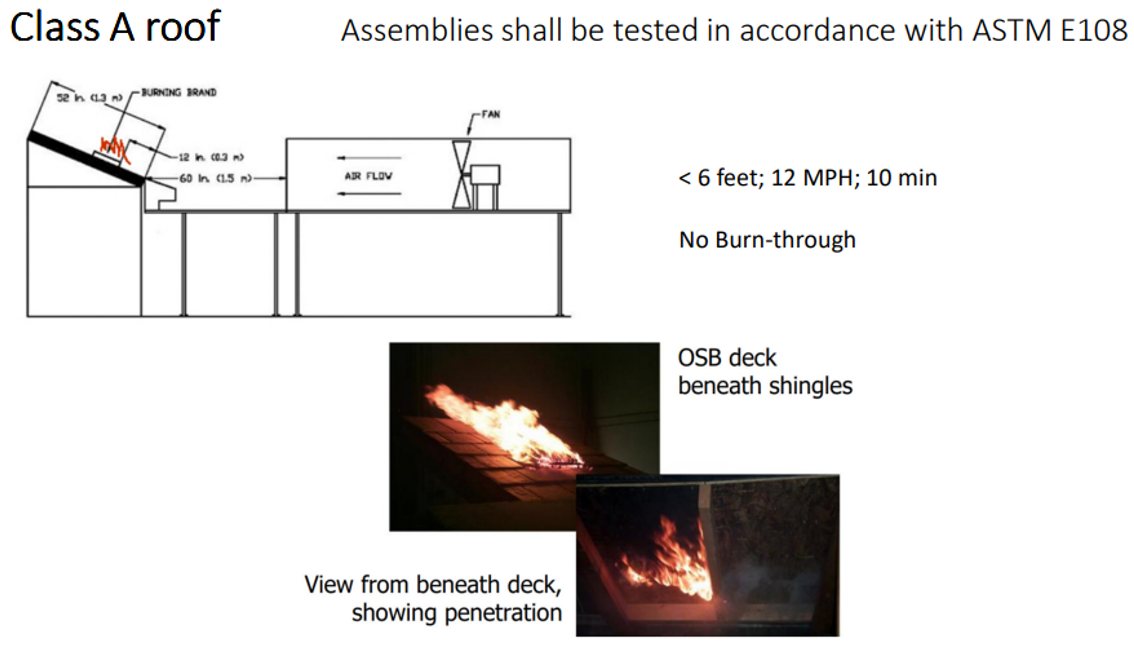
Fire hardening a building requires certain roofing and siding ignition resistance. NFPA 1144 and internal documents require a Class A roof system. Figures 15 and 16
show the ASTM E108 testing apparatus that gauges roof system performance in fire conditions.
Figure 15: Roof test.Figure 16: Roof test.
Siding also has specific requirements. NFPA 1144 requires the siding to be "ignition resistant" but fails to define this further with a metric. The IWUI
code has more information in terms of a definition. We are obligated to follow NFPA 1144; however, using a definition from IWUI or Chapter 7A of the CBC
allows for more repeatability in terms of application. It is recommended to have a Class B material based upon an extended ASTM E84 test. The extended ASTM E84
test is conducted for 30 minutes in a Steiner tunnel instead of the normal 10 minutes. This test is also referenced as the ASTM E2768 test. Regardless of the
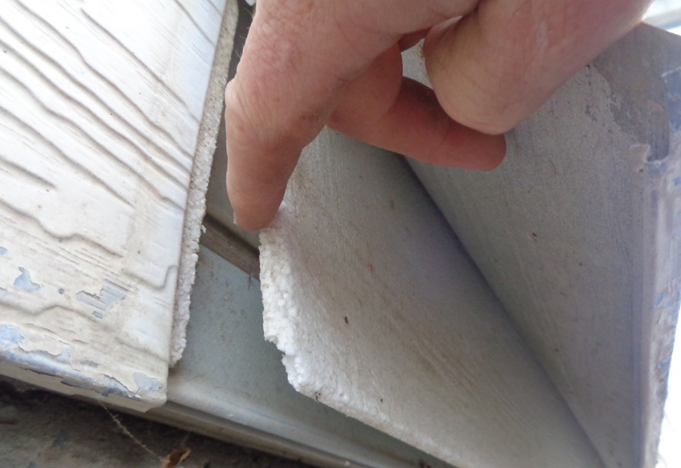
listing at the time of construction, continued maintenance is necessary. Figure 17 shown an example of siding where polystyrene is exposed. An ember could
easily land at this location and ignite this facility.
Figure 17: Siding maintenance.
NFPA 1144 Annex A recommends that trees are prevented from being placed where their mature canopy comes within 10' of a structure. This is a requirement in other WUI standards.
Figure 18 shows an example of pine needle accumulations on top of a roof. Trees adjacent to or hanging over a roof can create an exposre threat, but
they also deposit leaves and needles on the roof creating a location for ignition during an ember storm. Roof should be inspected at a frequency determined by how
much debris could accumulate. The pine needles shown in Figure 18 could create a fire that could burn through the decking and spread into the building, so
should be cleaned.
Figure 18: Vegetation debris on a roof.
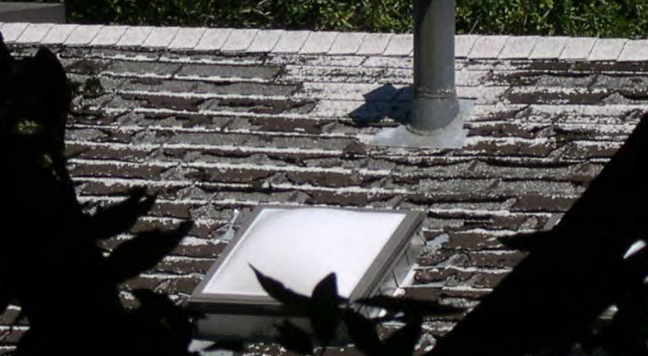
Time will wear a Class "A" roof to a lower rating. Roof systems need to be maintained and replaced based upon manufacturer's recommendation and general condition.
Figure 18.a shows and example of a Class "A" roof that is likely no longer at that listing due to age and weathering.
Figure 18.a: Roofs need maintenance and replacement.
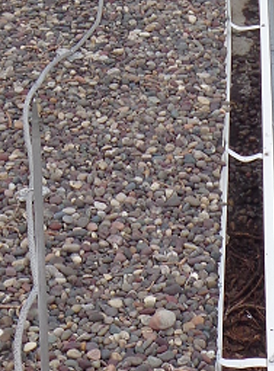
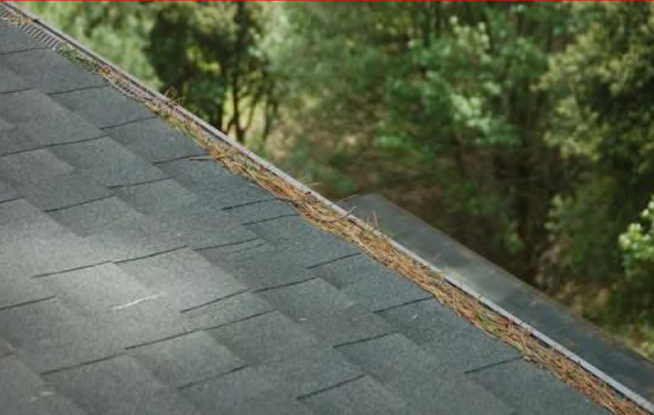
Another common problem is with accumulations of leaves within gutters as shown in Figure 19. An ember can easily ignite such dry leaves. A gutter with leaves is basically
a fuse looking for a weak link into a building. Although not required by NFPA 1144, other standards require that a leaf screen be placed over gutters to prevent such accumulations.
Figure 19: Vegetation debris in gutter.
Figure 19.a shows gutters with a screen that have a heavy load. Even screened gutters still need cleaning.
Figure 19.a: Vegetation debris on screened gutter.
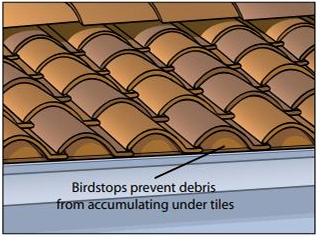
Installation practices for roofing and eaves should also be scrutinized. Gaps are required to be screened with a mesh that is no more than 1/8" in width. Holes should be
birdstoped as shown in Figure 20.
Figure 20: Bird-stopping roof systems.
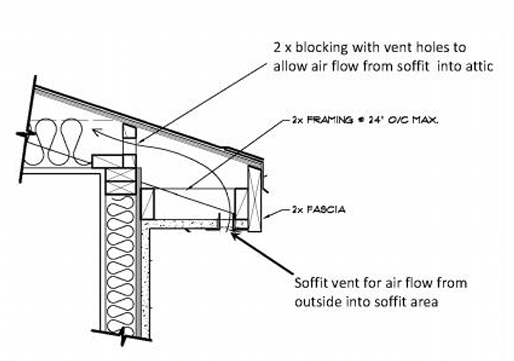
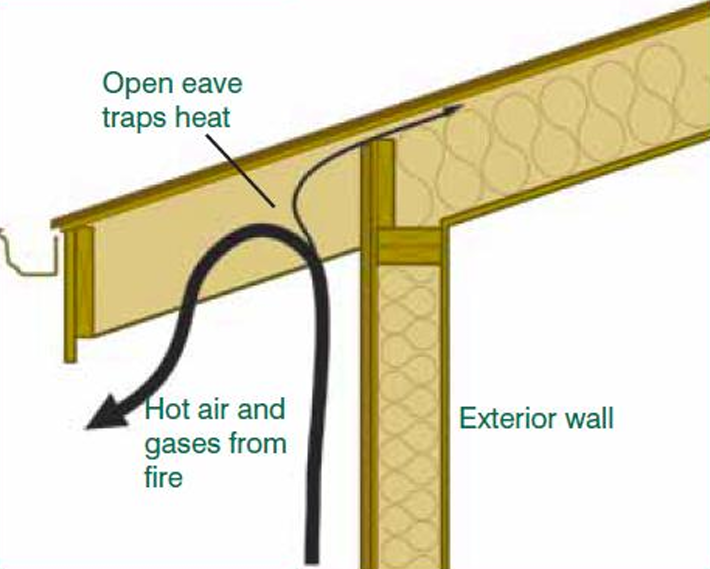
Eaves should be closed at a minimum as shown in Figure 21. Soffits keep heat from concentrating under the eaves.
Figure 20: Closed eaves.Figure 21.a: Soffits are necessary.
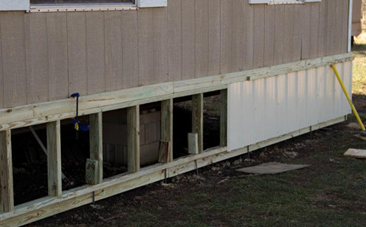
Skirting is necessary around trailers. Permanent office trailers require ignition resistant skirting per NFPA 1144. No combustible storage is permissible under
contractor trailers. Failure to skirt contractor trailers will result in accumulations of vegetation and the potential for using this area for storage. Temporary
contractor trailers can use a combustible material such as snow fenching with openings larger than 1/8" for the skirting based upon local AHJ interpretation.
Figure 22: Trailer skirting.
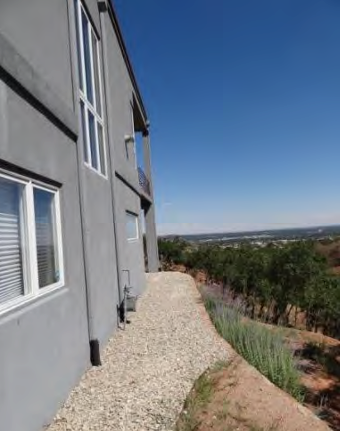
A 5' area around a structure should be non-combustible as shown in Figure 23.
Figure 23: Non-combustible zone.
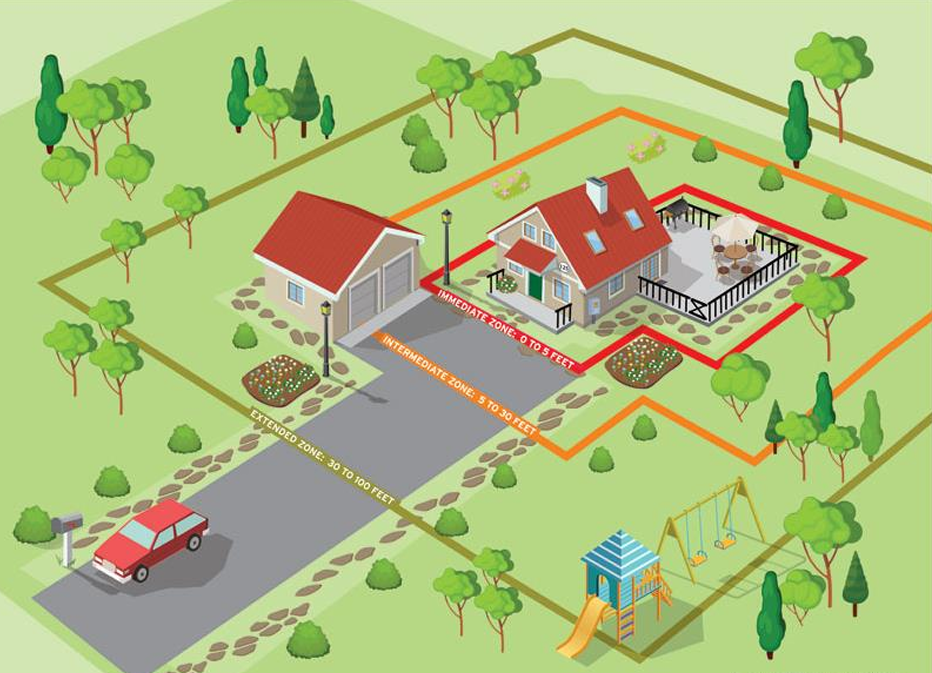
Figure 24 shows a recommended layout for a structure that includes no comubstibles within 5', followed by stages of a buffer zone.
Figure 24: Optimal layout for a structure.
The following is a list of requirements for new construction from the 2018 NFPA 1144:
Separation distance between primary and non-suppressed Type VB accessory structures shall not be less than 30 feet (NFPA 1144 Section 5.1.3.1).
IBC Table 602 distances can be used for separation based upon input from the Fire Code Official (FCO) where exposure potentials are considered.
Connex storage containers are not considered as buildings. They can be placed adjacent to each other and can be approved by the FCO to be closer to primary
structures than what is specified in IBC Table 602.
Only Class A roof systems shall be used (NFPA 1144 Section 5.3.1.1).
Roof gutters and accessories shall be non-combustible (Section 5.3.2).
Vents shall resist the intrusion of embers and shall be either screened with mesh openings not exceeding 1/8”, or having vents that demonstrate the ability to
resist the intrusion of flames and embers (Section 5.3.3).
Eaves shall be enclosed with ignition-resistant materials (Section 5.3.4).
Overhanging projections such as decks shall be constructed of ignition-resistant materials (Section 5.4).
Overhanging buildings shall have an underside that is ignition-resistant (Section 5.5).
Exterior vertical walls shall be ignition-resistant (Section 5.5).
Exterior windows, including those in doors, shall be tempered glass, multilayered glazed panels, or have a 20-minute fire-rating (Section 5.7.1).
Window screening shall be non-combustible (Section 5.7.2).
Exterior doors shall be non-combustible or have a 20-minute rating (Section 5.7.3).
Ignition-resistant skirts are required around permanently located trailers (Section 5.10.1).
The following are policies from the 2018 IWUI code for outdoor combustible storage and landscaping:
The projected distance between crowns of new trees and adjacent structures, including overhead electrical facilities, shall not be less than 10 feet.
New tree crowns extending to within 10 feet of any structure shall be pruned to maintain a minimum clearance of 10 feet.
Existing trees shall be trimmed to meet this goal provided that the life of the tree is not threatened.
New trees shall be trimmed so that limbs shall not be located less than six feet above the ground surface. Existing trees shall be trimmed to meet
this goal provided that the life of the tree is not threatened.
During the wildland fire season, piles of combustible materials exceeding 100 ft2 shall be stored a minimum of 20 feet from structures
and shall be separated from crowns of trees by a minimum horizontal distance of 15 feet.
Clearance between ignition sources and combustible materials shall be maintained at not less than 30 feet.
Smoking shall not occur within 15 feet of vegetation accumulations.
Planting decorative vegetation that at maturity would grow to within 10 feet of energized conductors shall not be permitted.
Outside storage of combustible materials shall have individual piles that shall not exceed 5,000 ft2 and shall be less than 10 feet high.
Maintain a non-combustible landscaped zone or a thoroughly irrigated area within five feet of the perimeter of all existing structures.
No combustible mulch is permitted.
How to make a decision regarding whether WUI standards should be enforced
A fire risk assessment based upon the information found at the Fire Risk Assessment portion of this website can provide
information on what an acceptable risk is. Realistically, for a site where HAZMAT is stored in large quantities, a nuclear or radiological site,
or other mission-critical location, a conflagration will results in casualties and serious environmental damage, in additional to the support such
a site offers to a particular mission. Acceptable risk for such situatins is on the order of 1E-6. Wildland fires naturally occur every
3-10 years if the area does not have suppression. The combination of a wildland fire with an extreme weather event such as high temperature, high winds
and low relative humidity could occur. The question is what frequency would such events happen? It is reasonable to conclude that a reaslistic
risk of 10-4 per year is applicable
where a devastating conflagration could occur resulting in serious casualties. That high level of risk justifies actions in terms of NFPA 1144 compliance.