Lead engineers are expected to understand the following:
How to calculate detector activation time.
How to calculate the size of a design fire.
How to calculate fire spread.
How to read an HRR graph and know sources (NFRL/NIST) where to find fire profiles.
Know the basics of a fire alarm system.
How to find the correct version of NFPA 72 for your application and understand the basic contents of this standard.
How to calculate the time for flashover.
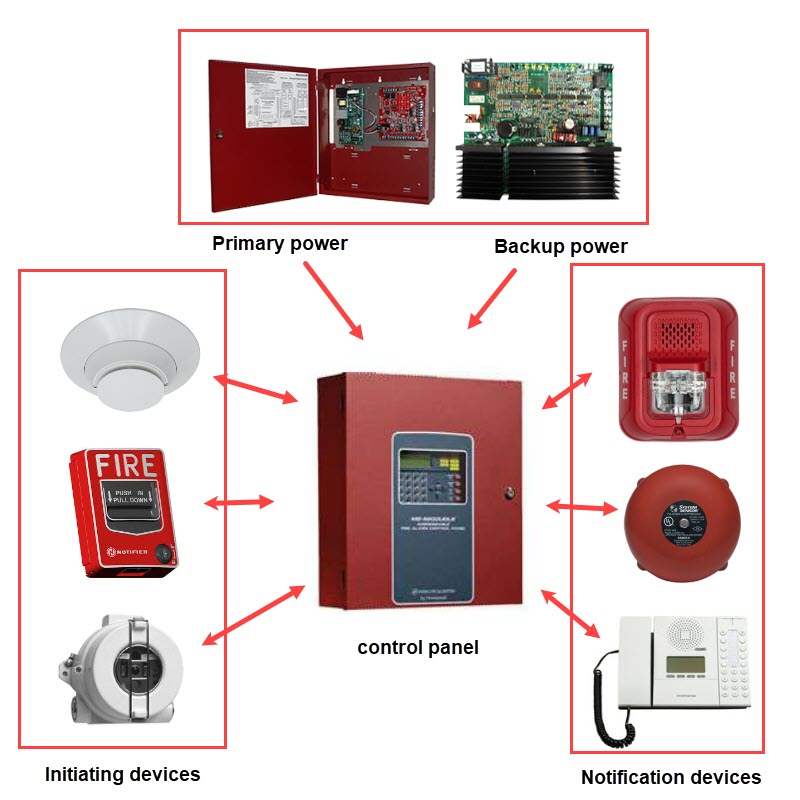
There are standard operational definitions used by our program that need to be understood when communicating information. Figure 1 shows basic information
for a fire alarm system (FAS). Our program mainly uses manual systems. Such systems depend on manual activation through the manual fire alarm pull stations (MPS). Even
though manual systems rely on MPS', they still are required to have automatic smoke detection at certain areas. A lead engineer is expected to know the basics
of an FAS and how to look up code requirements such as where smoke detectors are required to be for a manual system.
Figure 1: Nomenclature for FAS.
A battery backup system is required per NFPA 72 for an FAS. A lead engineer needs to be able to look up what the necessary components for an FAS are and
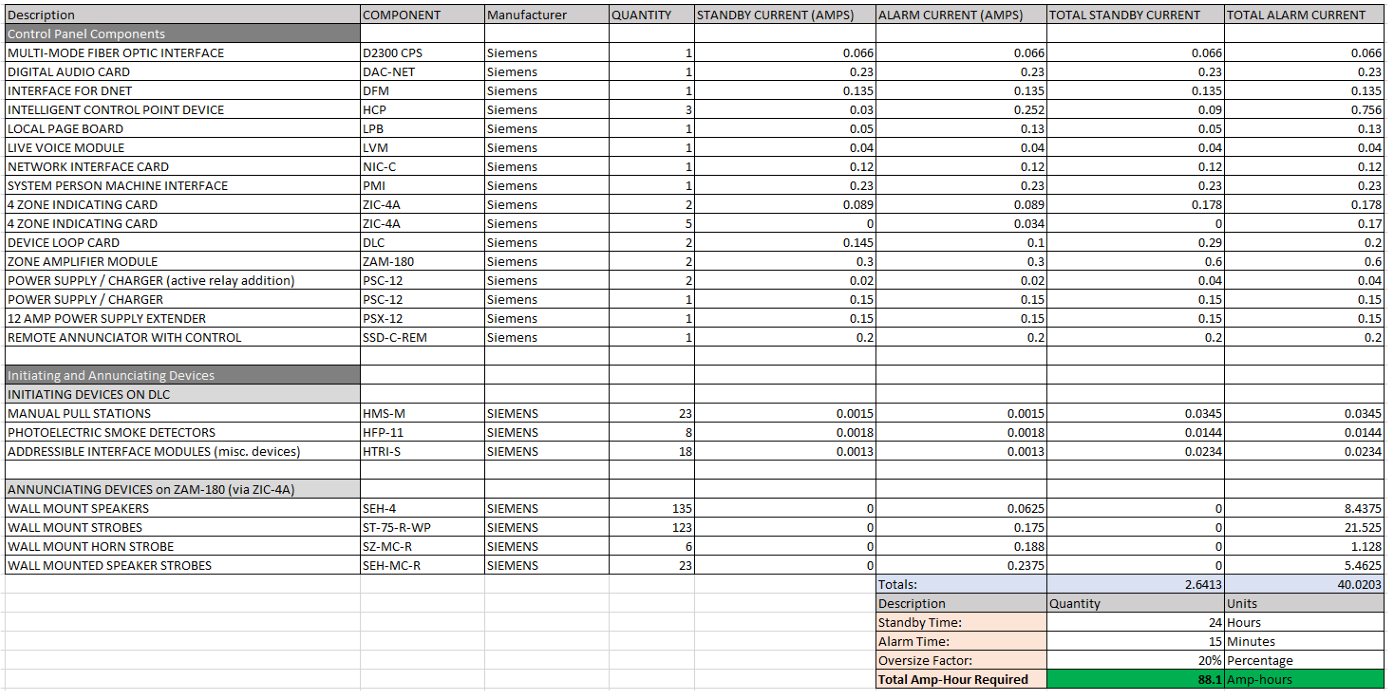
understand how to identify the power requirements. Figure 2 shows an example of battery calculations for one of the systems at our site. In this case,
a 100 amp/hr battery is in this system. The battery caculations show this is acceptable.
Figure 2: Battery Calculations.
Understanding fire spread and growth is a necessary part of FAS design. The primary purpose of an FAS to to detect that a fire is present and notify occupants so they can
safely egress. Understanding the nature of the fire helps the FAS designer to understand what the necessary detection time is.
A secondary purpose is to ensure manual suppression is prioritized by the fire department. Fire spread predominately occurs through radiative
heat transfer. Characterizing fire growth can use several tools including calculating the radiative heat transfer from a known fire or from a fire that
is estimated through calculational methods. Typically, the threshold for failure on a cellulose based combustible target is 10 kW/m2. A fire's
heat release rate (HRR) is proportional to the area on fire. As the fire moves radially from the point of ignition, the area on fire is proportion to the
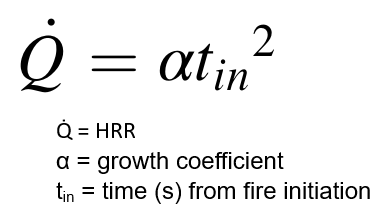
square of the radius of the fire. This concept leads to the "T"-squared fire formula, which is shown in Figure 3.
Figure 3: T-squared fire formula.
SFPE HFPE Chapter 40 discusses the T-squared fire in designing detection systems.
The α values for the growth coefficient can be found in Annex B of NFPA 72, and also shown in Table 40.4 of the SFPE HFPE. This T-squared formula shown in Figure 3
is frequently used throughout fire protection engineering. Fires derived from Figure 3 or other sources create an HRR that acts as a thermal radiation source. The
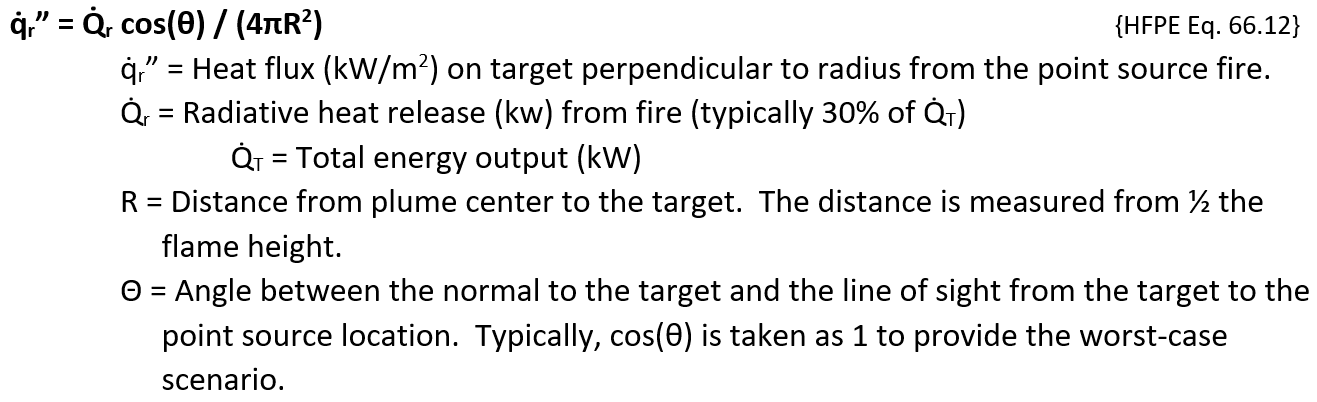
point source formula is frequently used when calculating the incidently radiative heat flux on a target.
Figure 4: Point source equation.
The point source equation for determining incidental heat flux is only valid if the target is at least twice the diameter of the fire away. When closer than two
diameters away from a fire, the radiation transport equation is necessary to calculate the incidental heat flux. A simplified version of this equation if found in
Figure 5. This is from SFPE HFPE Equation 34.6. Typically, this equation includes the additional multiplicative factors of absorptivity (α), transmissibility (τ),
and a view factor (φ). Usually, the α and τ values are considered unity and are omitted from this equation. σ = 5.67 E-8 kW/(m2 K4),
the view factor is a geometrical representation of how the target is seen by the fire.
Figure 5: Simplified Radiation Transport Equation.
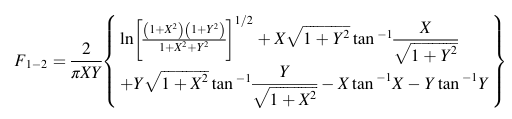
The view factor can be challenging to calculate. The formula for calculating the view factor is shown in Figure 6.
Appendix 4 of the SFPE HFPE has several graphs and formulas to assist with this. Figure A.6 is particularly usefull within
Appendix 4 for calculating the view factors commonly used for FPE related work at our sites. Without the view factor, the equation in Figure 5
gives a value that is too high, so the view factor is required for accuracy.
Figure 6: View factor equation.
Anytime that the incidental heat flux exceeds 10 kW/m2, it is assumed that ignition could occur. This is a very conservative threshold, but
one that provides a safety margin if errors occurred in setting up the problem. Typically, a critical heat flux (CHF) of 10 kW/m2 will not
start combustion. There are some materials where piloted combustion could occur at this CHF, but exposure would take a considerable amount of time to initiate combustion.
The main conclusion is that a higher heat flux is required to intiate combustion, and the larger the difference between the actual heat flux and the CHF, the
faster the combustion will occur. For instance, Douglass Fir has an auto-ignition heat flux of around 44 kW/m2. The 10 kW/m2 is a
piloted heat flux. This piloted CHF is where enough off-gassing could occur where the pyrolized gasses could ignite if exposed to an ignition source. Much more
heat flux is necessary to initiate combustion in the absence of an ignition source, such as a spark or an open flame.
In addition to the CHF, there is also an extinguishing heat flux. Due to charring, wood has a self extinguishing heat flux close to its auto-ignition heat flux.
This is the principle behind why wood beams in Type IV construction can have a good fire rating.
A flashover is a situation where a room or compartment fire goes from a fuel limited fire to an oxygen limited fire very quickly. This transition usually occurs
when the ceiling temperature is around 600° C with a heat flux on the floor of around 20 kW/m2. This situation usually drives the temperature up by about
900° C from ambient. This situation is not survivable. One primary purpose of a detection and notification system is to ensure occupants are notified and can
safely egress prior to flashover conditions.
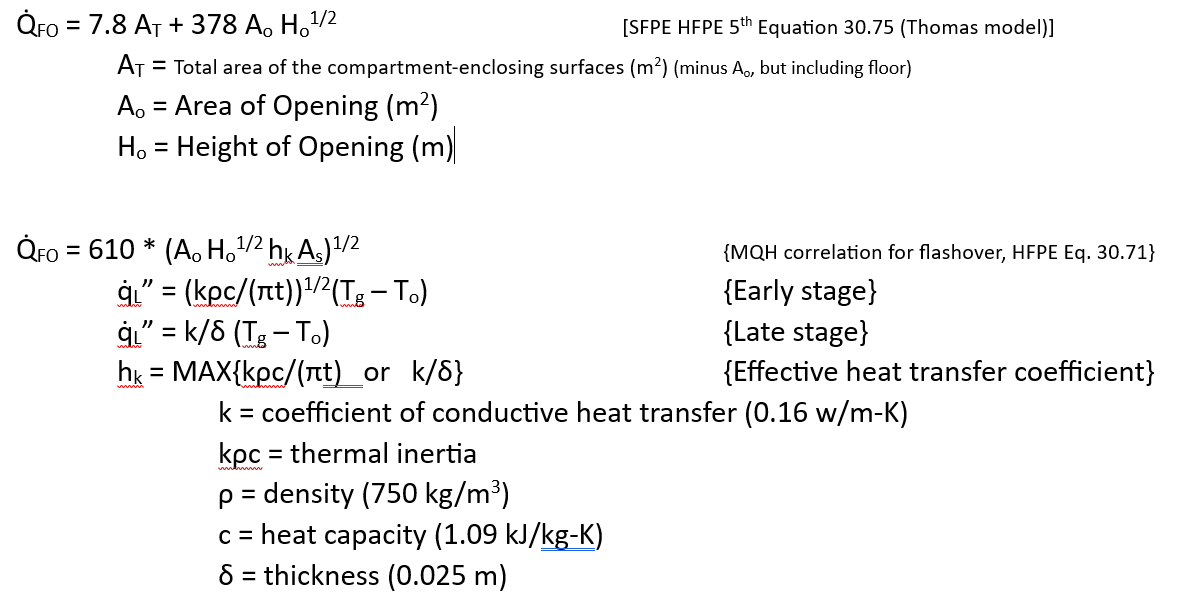
There are two primary equations provided in Chapter 30 of the SFPE HFPA used for calculating flashover. These equations are shown in Figure 7.
Figure 7: Flashover Models.
A simple example problem that illustrates fire spread
would be to determine what the heat flux from a stack of 5 pallets would be on an incidental target that is 10 feet away. The
HRR for pallets can be calculated from the pallet data in Annex B of NFPA 72. The point source equation can be used to determine what the heat flux is.
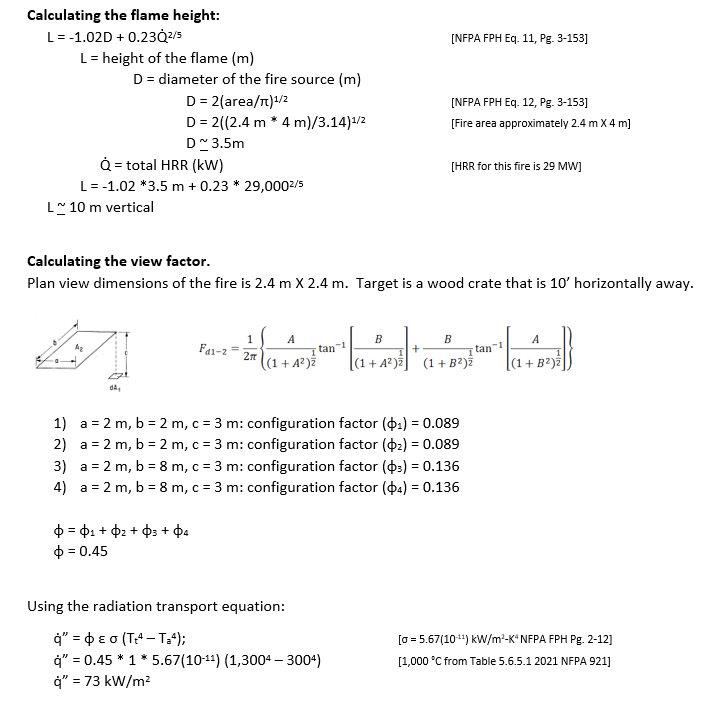
A more complex problem would be to determine what the incidental heat flux on a wood crate that is 10' from a fire that is 29 MW and is about 2.4 m X 4 m in size.
This is much more involved to solve than the point source approach as the proximity
of the wood crate is closer than 2 diameters from the fire. This requires the radiation transport equation. The solution is shown in Figure 8.
Figure 8: Solution to problem.
In this case from the solution shown in Figure 8, it is easy to predict that fire will rapidly spread to the adjacent wood crate as 73 kW/m2
is significantly more than the CHF.