Lead engineers are expected to understand the following:
Perform basic calculations for RSET and ASET.
Show an understanding of Chapter 10 and MOE applicable sections of Chapter 11 of the IFC.
The Available Safe Egress Time (ASET) is estimated by calculating how the speed of fire spread and the lowering smoke layer could impact egress.
Several tools are available to calculate ASET including the Fire Dynamics Simulation (FDS) software available for free from NIST and smoke layer equations
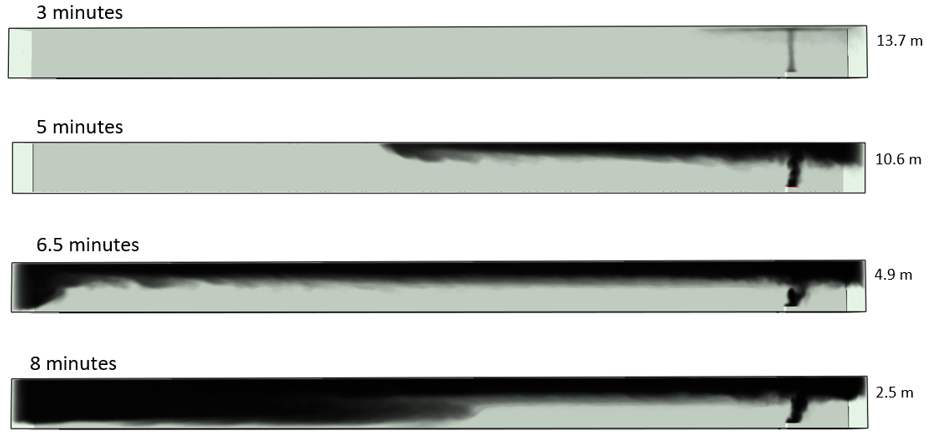
found in Chapter 51 of the SFPE HFPE. FDS can be used to validate the hand calculations. Figure 1 shows an example of a large highbay where a 30 MW
fire generates smoke on the far end. Hand calculations show a 20 minute RSET. FDS shows this value closer to 10 minutes. The hand calculations have
limitations regarding how they were derived. This is why it is beneficial to use FDS to validate unusual situations such as a long high-bay that behaves
like a corridor that channels smoke rather than an atrium that simply absorbs smoke from the top to the bottom. One definition of ASET is the time it takes
for smoke to lower to 6' above the floor in the path of egress travel.
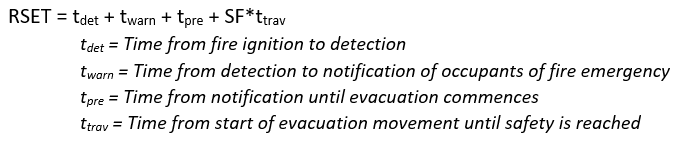
The Required Safe Egress Time (RSET) is the necessary time for detection, notification, pre-movement time and egress time. Several tools are available to
perform RSET calculations including software such as the PathFinder program by Thunderhead Engineering or hand calculations found in Chapter 59 of the SFPE HFPE.
Figure 1: FDS report showing smoke layer.
As previously stated, RSET can be broken into pieces as shown in Figure 2. The travel time is required by code to have a safety factor (SF) of 1.5 or more applied to it.
Figure 2: RSET Factors.